
Citations
Nonlinear electrical activity of beta brain waves during an alternating attention and interference inhibition test
Actividad eléctrica no lineal de las ondas beta cerebrales durante una prueba de atención alternante e inhibición de la interferencia
Open | Download
Section
Articles
How to Cite
Nonlinear electrical activity of beta brain waves during an alternating attention and interference inhibition test. (2022). Revista EIA, 19(38), 3812pp. 1-14. https://doi.org/10.24050/reia.v19i38.1544
Dimensions




license

This work is licensed under a Creative Commons Attribution-NonCommercial-NoDerivatives 4.0 International License.
Copyright statement
The authors exclusively assign to the Universidad EIA, with the power to assign to third parties, all the exploitation rights that derive from the works that are accepted for publication in the Revista EIA, as well as in any product derived from it and, in in particular, those of reproduction, distribution, public communication (including interactive making available) and transformation (including adaptation, modification and, where appropriate, translation), for all types of exploitation (by way of example and not limitation : in paper, electronic, online, computer or audiovisual format, as well as in any other format, even for promotional or advertising purposes and / or for the production of derivative products), for a worldwide territorial scope and for the entire duration of the rights provided for in the current published text of the Intellectual Property Law. This assignment will be made by the authors without the right to any type of remuneration or compensation.
Consequently, the author may not publish or disseminate the works that are selected for publication in the Revista EIA, neither totally nor partially, nor authorize their publication to third parties, without the prior express authorization, requested and granted in writing, from the Univeridad EIA.



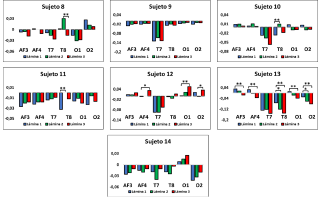
Introduction: Alternating attention is a process that allows you to change the focus of attention from one stimulus to another quickly. Meanwhile, the inhibition of interference corresponds to the ability to inhibit automatic responses, which allow a controlled response to conflicting stimuli. Aim: study the non-linear behavior of the beta oscillation (13-30 Hz) of the EEG, evaluated through brain chaos/order balance, during the execution of an alternating attention test and a test of interference inhibition in university students. Method: The sample consisted of 14 male university students. For the electroencephalographic recording, the brain-interface device Emotiv Epocø Research Edition was used using the frontal, temporal and occipital lobe registers. The frequency range of 13 to 30 Hz (beta wave) was analyzed. For the evaluation of alternating attention, the Smith test was used and for the inhibition of interference, the Stroop test was used. Results: during the alternating attention test and interference inhibition the values of the Hurst exponents tend to decrease, which accounts for the existence of more complex processes resulting from the disorganization of the activity of these barks. There are few asymmetries between left and right crusts, and few correlations during the resolution of both tests. Conclusion: Hurst exponents tend to decrease during the resolution of the alternating attention and interference inhibition test, being this a suitable process for the resolution of cognitive problems.
Article visits 939 | PDF visits 456
Downloads
Download data is not yet available.
- Arouxet, M.; Pastor, V. (2017). Estudio del exponente de Hurst. Mecánica Computacional, 35: pp.2503-2510.
- Bear, M.; Connors, B.; Paradiso, M. (2016). Neurociencia, la exploración del cerebro. 4° ed. Madrid, Wolters Kluver.
- Cabrales, A. (2015). Neuropsicología y la localización de las funciones cerebrales superiores en estudios de resonancia magnética funcional con tareas. Acta Neurol Colomb, 31(1): pp.92-100.
- Capra, F. (1998). La trama de la vida. Barcelona: Anagrama.
- De Vega, M. (1998). Introducción a la Psicología Cognitiva. Madrid: Alianza.
- Diamond, A. (2013). Funciones ejecutivas. Revisión Anual de Psicología, 64: pp.135-168.
- Díaz, H.; Maureira, F.; Córdova, F.; Palominos, F. (2017). Long-range linear correlation and nonlinear chaos estimation differentially characterizes functional conectivity and organization of the brain EEG. Procedia Computer Science, 122: pp.857-864. https://doi.org/10.1016/j.procs.2017.11.447
- Díaz, H.; Maureira, F.; Córdova, F. (2017). Temporal scaling and inter-individual hemispheric asymmetry of chaos estimation from EEG time series. Procedia Computer Science, 122: pp.339-345. https://doi.org/10.1016/j.procs.2017.11.378
- Euler, M.; Wiltshire, T.; Niermeyer, M.; Butner, J. (2016). working memory performance inversely predicts spontaneous delta and theta-band scaling relations. Brain Research, 1637: pp. 22-33. http://dx.doi.org/10.1016/j.brainres.2016.02.008
- Flores, F.; Maureira, F; Díaz, H.; Navarro, B.; Gavotto, O.; Matheu, A. (2019). Efectos de una sesión de ejercicio físico sobre la actividad neurofisiológica durante la resolución de una prueba de atención selectiva. Retos, 36: pp.390-396. https://doi.org/10.47197/retos.v38i38.74648
- Flores, J.; Castillo, R.; Jiménez, N. (2014). Desarrollo de funciones ejecutivas, de la niñez a la juventud. Anales de Psicología, 30(2): pp.463-473.
- Grodzinsky, G.; Diamond, R. (1992). Frontal lobe functioning in boys with attention-deficit hyperactivity disorder. Developmental Neuropsychology, 8(4): pp.427-445.
- Jausovec, N.; Jausovec, K. (2010). Resting brain activity: differences between genders. Neuropsychologia, 48(13): pp.3918-3925. https://doi.org/10.1016/j.neuropsychologia.2010.09.020
- Kale, M.; Butar, F. (2011). Fractal analysis of time series and distribution properties of Hurst exponent. Journal of Mathematical Science and Mathematics Education. 5: pp.8-19.
- Klonowski, W. (2016). Fractal análisis of electroencephalographic time series (EEG signals), Di Leva, A. The fractal geometry of the brain, New York: Springer-Verlag, pp.413-429.
- Lebowitz, J. (2000). La entropía de Boltzmann y la flecha del tiempo. Rev Esp de Fís, 14(4): pp.26-31.
- Maureira, F.; Díaz, H. (2021). Actividad eléctrica no lineal de las ondas beta cerebrales durante una prueba de atención sostenida. Revista EIA, 18(36): pp.1-13. https://doi.org/10.24050/reia.v18i36.1506
- Maureira, F.; Díaz, H.; Hadweh, M.; Bravo, P.; Flores, E. (En prensa). Análisis no-lineal de la onda gamma del EEG en una prueba de atención e inhibición. Revista Cubana de Investigaciones Biomédicas.
- Maureira, F.; Díaz, H.; Hadweh, M.; Flores, E.; Silva, A. (2021). Estabilidad de las correlaciones de la actividad eléctrica no lineal del cerebro durante un estado de reposo con los ojos cerrados. Revista EIA, 18(35): pp.1-13. https://doi.org/10.24050/reia.v18i35.1463
- Maureira, F.; Flores, E. (2020). Estabilidad de la actividad eléctrica no lineal durante condiciones basales con los ojos cerrados. Revista Cubana de Investigaciones Biomédicas, 39(3): pp.e626.
- Maureira, F.; Flores, E.; Díaz, H. (2020). Diferencias inter e intra-hemisféricas de dinámicas no lineales en las señales de electroencefalograma durante la resolución de una prueba de atención. Revista de la Facultad de Medicina, 68(4): pp.577-585.
- Maureira, F. (2018). Principios de neuroeducación física. 2° ed. Madrid: Bubok Publishing.
- Natajaran, K.; Acharya, R.; Alias, F.; Tiboleng, T.; Puthusserypady, S. (2004). Nonlinear analysis of EEG signals at different mental states. BioMedical Engineering OnLine, 3: pp.7. https://doi.org/10.1186/1475-925X-3-7
- Portnova, G.; Atanov, M. (2016). Age-dependent changes of the EEG data: comparative study of correlation dimension D2, spectral analysis, peak alpha frequency and stability of rhythms. International Journal of Innovative Research in Computer Science & Technology, 4(2): pp.5661.
- Ramos, F.; Morales, G.; Egozcue, S.; Pabón, R.; Alonso, M. (2009). Técnicas básicas de electroencefalografía: principios y aplicaciones clínicas. An Sist Sanit Navar, 32(S3): pp.69-82.
- Ramos, C.; Paredes, L.; Andrade, S.; Santillán, W.; González, L. (2016). Sistemas de atención focalizada, sostenida y selectiva en universitarios de Quito-Ecuador. Rev. Ecuat. Neurol, 25(1-3): pp.34-38.
- Rodríguez, R. (2014). El coeficiente de Hurst y el parámetro α-estable para el análisis de series financieras. Aplicación al mercado cambiario mexicano. Contaduría y Administración, 59(1): pp.149-173.
- Smith A. (1973). Symbol digit modalities test manual. Los Ángeles: Western Psychological Services.
- Stelzer, F.; Cervigni, M.; Martino, P. (2010). Bases neurales del desarrollo de las funciones ejecutivas durante la infancia y adolescencia. Una revision. Revista Chilena de Neuropsicología, 5(3): pp.176-184.
- Stroop J. (1935). Studies of interference in serial verbal reaction. Journal Expedients Psychology, 18: pp.643-662.
- Styles, E. (2010). Psicología de la atención. Madrid: Universitaria Ramón Areces.
- Thakor, N.; Tong, S. (2004). Advances in quantitative electroencephalogram analysis methods. Annu. Rev. Biomed, 6: pp.453-495.
- World Medical Asociation. (2013). World Medical Association Declaration of Helsinki Ethical Principles for Medical Research
- Involving Human Subjects. JAMA, 310(20): pp.2191-2194. https://doi.org/10.1001/jama.2013.281053
- Zarjam, P.; Epps, J.; Lovell, N.; Chen, F. (2012). Characterization of Memory Load in an Arithmetic Task using Non-Linear Analysis of EEG Signals. Annual International Conference of the IEEE Engineering in Medicine and Biology Society. https://doi.org/10.1109/embc.2012.6346725