
Citations
Proposal for numerical modeling of metallic hysteretic dissipators type TADAS, in concrete and steel frame buildings
Propuesta de modelación numérica de disipadores histeréticos metálicos tipo TADAS, en edificaciones de pórticos de concreto y acero
Open | Download
Section
Articles
How to Cite
Proposal for numerical modeling of metallic hysteretic dissipators type TADAS, in concrete and steel frame buildings. (2023). Revista EIA, 20(40), 4013 pp. 1-20. https://doi.org/10.24050/reia.v20i40.1688
Dimensions




license

This work is licensed under a Creative Commons Attribution-NonCommercial-NoDerivatives 4.0 International License.
Copyright statement
The authors exclusively assign to the Universidad EIA, with the power to assign to third parties, all the exploitation rights that derive from the works that are accepted for publication in the Revista EIA, as well as in any product derived from it and, in in particular, those of reproduction, distribution, public communication (including interactive making available) and transformation (including adaptation, modification and, where appropriate, translation), for all types of exploitation (by way of example and not limitation : in paper, electronic, online, computer or audiovisual format, as well as in any other format, even for promotional or advertising purposes and / or for the production of derivative products), for a worldwide territorial scope and for the entire duration of the rights provided for in the current published text of the Intellectual Property Law. This assignment will be made by the authors without the right to any type of remuneration or compensation.
Consequently, the author may not publish or disseminate the works that are selected for publication in the Revista EIA, neither totally nor partially, nor authorize their publication to third parties, without the prior express authorization, requested and granted in writing, from the Univeridad EIA.

Show authors biography


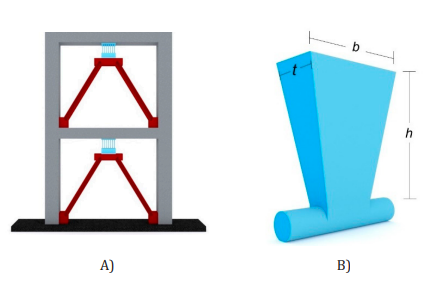
This article proposes a methodology for modeling TADAS (Triangular Added Damping and Stiffness) metallic hysteretic dampers in moment-resisting concrete and steel frame buildings, which have special energy dissipation capacity. For this purpose, SAP 2000 software was used to carry out the modeling and nonlinear static analysis of progressive plastification of buildings. During the research, the fuse-type behavior of the dampers could be identified, which enter the inelastic range before the structural elements of the main seismic resistance system. In addition, it was observed that the inclusion of these devices in moment-resisting frames improved the capacity of the buildings against lateral loads.
Article visits 1523 | PDF visits 306
Downloads
Download data is not yet available.
- Aguiar, R. (2018). Analysis of Used Dissipators in Reinforcement of Hospital Rodríguez Zambrano De Manta. 23, 1–28.
- AIS, A. C. de I. S. (2010). NSR10. Reglamento Colombiano De Construcción Sismo Resistente Nsr-10, 590.
- American Society of Civil Engineers. (2016). ASCE STANDARD ASCE/SEI 7-16 Minimum Design Loads and Associated Criteria for Buildings and Other Structures. In ANSI/ASCE Standard (Issue 7 98).
- Caballero Castro, L. (2022). Evaluación del coeficiente de disipación de energía R, en edificaciones de pórticos en acero, provistos con disipadores histeréticos metálicos triangulares tipo TADAS, localizadas en zona de amenaza sísmica alta (Magister en Ingenieria -Estructuras), Bogotá, Colombia, Universidad Nacional de Colombia. https://repositorio.unal.edu.co/handle/unal/82844
- Cano Castaño, H. (2020). Evaluación del coeficiente de disipación de energía R, en edificaciones de concreto reforzado con disipadores histeréticos metálicos triangulares tipo TADAS, ubicados en zona de amenaza sísmica alta (Magister en Ingenieria -Estructuras), Bogotá, Colombia, Universidad Nacional de colombia. https://repositorio.unal.edu.co/handle/unal/78657
- Constantinou, M. C.; Soong, T. T.; Dargush, G. F. (1998). Passive Energy Dissipation System for Structural Desing and Retrofit.
- Dareini, H. S.; Hashemi, B. H. (2011). Use of dual systems in tadas dampers to improve seismic behavior of buildings in different levels. Procedia Engineering, 14, 2788–2795. https://doi.org/10.1016/j.proeng.2011.07.351
- Keh-Chyuan T.; Huan-Wei C.; Ching-Ping H.; Yung-Feng S. (1993). Design of steel triangular plate energy absorbers for seismic-resistant construction. Earthquake Spectra, 9, (3), 505–528. https://doi.org/10.1193/1.1585727
- Mahmoudi, M.; Abdi, M. G. (2012). Evaluating response modification factors of TADAS frames. Journal of Constructional Steel Research, 71, 162–170. https://doi.org/10.1016/j.jcsr.2011.10.015
- Mohammadi, R. K.; Nasri, A.; Ghaffary, A. (2017). TADAS dampers in very large deformations. International Journal of Steel
- Structures, 17(2), 515–524. https://doi.org/10.1007/s13296-017-6011-y
- Oviedo A., J. A.; Midorikawa, M.; Asari, T. (2010). Earthquake response of ten-story story-drift-controlled reinforced concrete frames with hysteretic dampers. Engineering Structures, 32(6), 1735–1746. https://doi.org/10.1016/j.engstruct.2010.02.025
- Oviedo Amézquita, J.; Duque Uribe, M. (2009). Situación de las técnicas de control de respuesta sísmica en Colombia. Revista EIA, 6(12), 113–124. https://doi.org/10.24050/reia.v6i12.224
- Palazzo, G.; Francisco, J.; Crisafulli, F. (2018). Evaluación De La Eficiencia De Disipadores Por Fluencia Usados Para La Rehabilitación De Pórticos. Simposio “El Hormigón Estructural y El Transcurso Del Tiempo”, May 2015.
- Peña, C.; Urzúa, C. (2019). Implementación de BRB en edificio industrial mayor. Aplicación en Chile. XII Congreso Chileno de Sismología e Ingeniería Sísmica, April.
- Rochel, R. (2012). Análisis y diseño sísmico de edificios.
- Saeedi, F.; Shabakhty, N.; Mousavi, S. R. (2016). Seismic assessment of steel frames with triangular-plate added damping and stiffness devices. Journal of Constructional Steel Research, 125, 15–25. https://doi.org/10.1016/j.jcsr.2016.06.011
- Soong, T.; Dargush, G. F. (1999). Passive Energy Dissipation Systems in Structural Engineering. In Journal of Engineering Mechanics, 125, (3). https://doi.org/10.1061/(asce)0733-9399(1999)125:3(371)
- TahamouliRoudsari, M.; Eslamimanesh, M. B.; Entezari, A. R.; Noori, O.; Torkaman, M. (2018). Experimental Assessment of Retrofitting RC Moment Resisting Frames with ADAS and TADAS Yielding Dampers. Structures, 14, 75–87. https://doi.org/10.1016/j.istruc.2018.02.005
- Tena Colunga, A. (2000). Modelado Analítico de Edificios con Disipadores de Energía. Revista de Ingeniería Sísmica, 62(62), 29. https://doi.org/10.18867/ris.62.253
- Tena Colunga, A. (2003). Disipación Pasiva de Energía en México : Un Estado del Arte.
- Xia chuan. (1992). Influence of Adas Element Parameters On. 118(7), 1903–1918.
- Zongjing, L.; Ganping, S. (2020). Test and evaluation of modified TADAS devices with different grades of steel. Earthquake Engineering and Engineering Vibration, 19(2), 451–464. https://doi.org/10.1007/s11803-020-0573-y